Hi
,
Surely people would believe if they saw clear evidence? Continuing from last week...
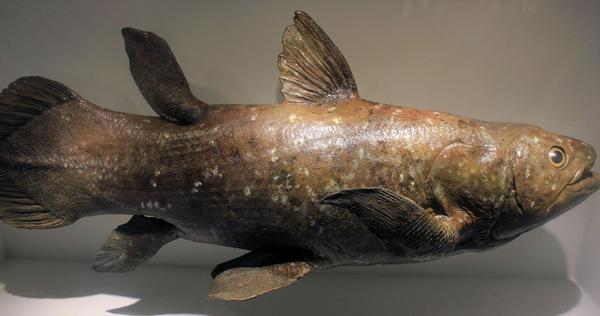
Consider the case of the coelacanth. This is a fish that evolutionists deemed to have gone extinct around 70 million years ago. Supposedly a link between fish and amphibians, scientists were dumbfounded at the discovery, in the 1950s, of a live
coelacanth off the east coast of South Africa. Many have since been found. Did this discovery turn the tables on the evolutionists? No, they simply called them "living fossils" that somehow evaded evolutionary processes over a period of 400 million years! Indeed! "Seeing" eyes stayed blind in this case.
More recently, however, was the discovery of "stretchy" organic material deep inside dinosaur bones. That is, of course, quite impossible if they are 65 million years old! The only alternative is that they are much younger! Did this
discovery change the minds of evolutionists? It certainly should have! Their response was to criticize the ones who discovered it (evolutionists, I might add!). And, what about carbon-14 found in dinosaur bones? It CAN'T be there, of course, if the bones are 65 million years old! What was their response when it was found? They claimed that the bones were contaminated...!!
Obviously, seeing isn't always believing. Francis Crick, Nobel laureate, writes, "Biologists must constantly keep in mind that what they see was not designed, but rather, evolved." I get a kick out of that ~ They have to constantly remind
themselves?! It's a little like Richard Dawkins also trying desperately to evade the obvious: "Biology is the study of complicated things that give the appearance of having been designed..."
This is pure, willfully blind bias - people willfully choosing not to see. Simon and Garfunkel, in their song, The Boxer, put it this way: "...a man hears what he wants to hear and
disregards the rest." My brother, John, in referring to this kind of bias, states: "What you believe determines what you see." How true! We "see" (interpret) data through the lens of what we truly believe.
So, this brings me to a final thought: From the perspective of someone who doesn't trust in Christ, he believes that those of us who do, are wrong. He would then conclude that we are fools. That's what he "sees". The apostle Paul says, "For the preaching of the cross is to them that perish foolishness; but, to us which are saved, it is the power of God" (1
Cor. 1:18). Conversely, we would agree with Paul when he writes, "...The wisdom of this world is foolishness with God..." (1 Cor. 3:19).
So, apparently, we humans are all fools, but for different reasons - depending on what we believe! I prefer this perspective, found in verse 18: "Let no one deceive himself. If anyone among you thinks that he is wise in this age, let him become a fool so that he may become wise."