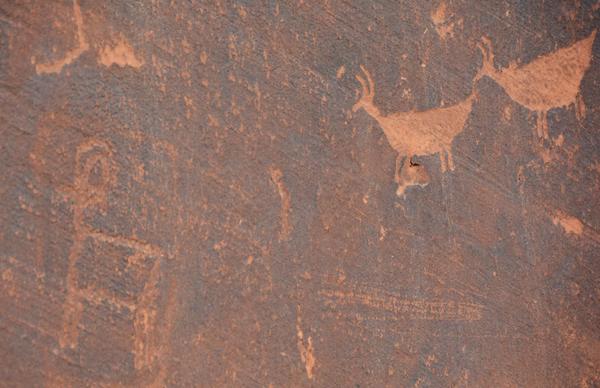
However, some petroglyphs appear darker, like the one in the lower left portion of this photo. It's not as light as the ones in the upper right portion. That's because there's more desert glaze on the one to the left. That means that it's older.
It takes quite a while to form, relatively speaking. but it's also somewhat measurable since these petroglyphs prove differences in age.
Now, put 2+2 together. If the growth rate is measurable, at least to a reasonable degree, then the total thickness of the glaze anywhere can't be more than just a few thousand years old. That would be consistent with it beginning to form after the global flood - roughly 4,500 years ago. If the glaze started growing a million years ago, there should be at least half an inch in most places. If it started growing 100 million years
ago, --- well, you do the math!
Which view is more reasonable? If the varnish is millions of years old, then all petroglyphs, regardless of when they were carved (whether hundreds or even 1,000+ years ago) should have the same appearance! The fact that some are definitely darker than others proves empirically that there is a measurable rate that is much faster than millions of years!
The Bible clearly teaches that the earth is measurable in thousands of years, not millions or billions. This is more evidence of that.